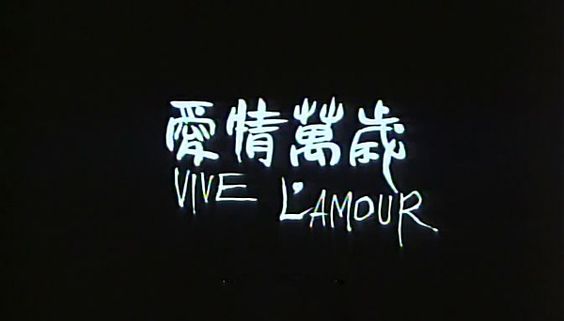
The Malaysia-born Taiwanese director, Tsai Ming-liang, is distinctive in Taiwanese cinema compared to equally well-known Edward Yang and Hou Hsiao-hsien, who are representatives of Taiwanese New Cinema. Instead of showing the rural views and hsiang-tu[1]culture of Taiwan as Hou and Yang did in 1980s, Tsai focuses on the living of city dwellers and is famous for his formalist experiment in long takes, slowness and few dialogues. As James Udden claims that “the films of Hou Hsiao-Hsien and Edward Yang are for the most part unthinkable without Taiwan. With Tsai [Ming-Liang], however, it is debatable whether these films are specifically about Taiwan or not”[2], the almost invariable theme of people’s solitude and alienation in Tsai’s works is not exclusive to Taiwan. This essay will analyse his Vive L’Amour (Ai qing wan sui, 1994) as an example and argues that Taiwan or Taipei, the city where this film was shot, is not an indispensable setting, but haunting in the film now and then. It is a similar case for his situation in Taiwanese New Cinema, as he is generally categorised in the “second wave” of it[3], yet vaguely on the edge.
Taiwanese New Cinema features its presentation and interpretation of Taiwan’s history on the screen, through which the films explore and examine the cultural and national identities of this island and common experiences of the people[4]. Even if in mid-1990s Hou and Yang began to change their attention from the traditional culture and nostalgia to the urban metropolitan culture and materialism[5], their works, except for those not set in Taiwan, are still identifiably Taiwan-centred. Tsai’s works also focus on the Taiwanese and are set in a highly capitalist and urbanised version of Taiwan, which is an outcome of modernisation; nevertheless, he concerns more about the inclusivity and universality of human nature and human desires. His films are naturalistic “minutiae of behaviour and environment”[6], thus accurately describing people’s daily lives. Yet Taipei, the city where Vive L’Amour was shot, seems not to serve as a unique background as the identifiability and the peculiarity of its appearance in the past has been transformed due to the massive construction and demolition of the urban infrastructure. His portrait of Taipei is detailed, mainly showing the empty houses for sale, cars (instead of people) on the road, a shopping centre, workplaces and a forest park, along with the sound of “electro-drones of car alarms and street-crossing signals competing with the constant chirruping of cell phones and doorbells”[7], yet they are not exclusive to Taipei. The highlighted sense of alienation and isolation shared by his three protagonists because of urbanisation can be found in most of the metropolitans, not necessarily in Taipei.
Despite sufficient displays of outdoor scenes of Taipei, most of the scenes are indoor in confined space such as the empty house, Lin’s own cramped apartment, a columbarium store and a café, which imply the director’s emphasis on individuals’ inside world. These places are also prevalent in every city, subverting the peculiarity of Taipei. The characters are alienated from other people and Taipei, as Hsiao Kang seems to be an invisible “ghost”[8] to the workers playing games at a workplace and Lin’s words are always ignored by her customers[9]. There are few dialogues in this film, most of which are around buying and selling, thus intensifying the materialism and utilitarianism in this society. Additionally, the three characters are usually alone, and even they meet each other, they tend not to talk a lot. For instance, Lin and Ah Jung do not talk face to face when they have sex; their only conversations exist via phone calls. Tsai seems to discover and exaggerate how people alienate from each other and how the city alienates them. Without enough depiction of human connection or their connection with the city, it is the materialism being stressed, not Taipei’s culture, history or itself. It has lost its local cultural identity and identities of place during modernisation; therefore, the new metropolitan culture is homogenised with other developed cities in the world.
Yet there is an exception of this universality, which is the Ta-an Forest Park in the last scene where Lin keeps crying for six minutes, serving as a hint of the history exclusive to Taiwan. The park was a debated construction project, as the site was previously a residential area for veterans of Chiang Kai-shek’s military, but 1257 houses were declared illegal and 1348 were demolished in 1992 in order to construct the new park[10]. Hence, the park serves as a symbol of the “gone city”, for which Lin is appointed as a mourner[11]. Braester also takes it as a connotation of “strong-handed government intervention in urban planning, disregard of city dwellers, and political dispute over Taiwan’s national myths”, underlining the history of gentrification in this particular city incorporated into the film and thus, the film’s concern about the city. In this way, Tsai could be interpreted as focusing on the contemporary stage of Taiwan in history, which has lost its identifiable Taiwanese character. Rather than recalling the past time and expressing the nostalgia, he concerns about the current city development and the “reformulation of the cultural landscape”[12], of which the topic is shared by Hou’s and Yang’s later works.
Another paradox can be found on the three protagonists who belong to nowhere, yet this lack of belonging to Taipei occurs when they inhabit Taipei. Lin, Ah Jung and Hsiao Kang should have their own places to live, yet they all take the empty house for sale as a refuge, where they sleep, bathe, have meals and have sex, implying that they cannot find a real home in Taipei. When Lin cries in the park, she still makes no connection to this place and seems just to find somewhere to sit down and cry. More accurately, she is a mourner for herself who can never build an intimate relationship with others. In this way, Taipei is only a name for the space where these “lost souls”[13] inhabit, but not a place with any special meaning to them. Tsai observes the damage of identity and culture imposed by modernisation and materialism upon the city dwellers and the loneliness they suffer from[14], but tends not to confine this phenomenon to Taipei. What is reflected in Vive L’Amour is not merely the cityscape and city dwellers of Taipei, but the emotion and the living condition shared by people throughout the world. This results in Taipei’s ambiguous situation in the film, as the protagonists are influenced by the urban development in the city, yet this influence is neither exclusive to the people nor to the city. Even the “look and sound” of present-day Taipei are demonstrated clearly, people’s lack of contact with the city also separates the city apart from their life. The meaning of Taipei where the Taiwanese live is reduced to merely a place holding rootless, homeless people. In other words, the city is in solitude in the film as well, which does not serve as part of the mise-en-scène, but merely a stage where the events take place.
With Tsai’s distinctive style of slowness and less thematic connection to Taiwan as a setting, it is debatable whether he should be categorised in Taiwanese New Cinema. This movement can also be named as “Taiwan New Cinema”, “New Taiwanese Cinema” or “Taiwanese New Wave”, hence being confusing and vague to some extent. Tsai distinguishes himself from this movement and has hinted at being not welcomed at first by some renowned directors[15]; while in most cases, he is still discussed under this heading owing to his works being based in Taiwan and his showing of Taiwan people. Therefore, it seems to be a compromising solution to situate him in the “second wave” of this movement which is more varied in styles and themes. The second wave or Second New Wave is considered to continue the “thematic cutting edge” in the first wave distinguished from melodramas, martial-arts films and the “Healthy Realist” cinema with Confucian ethics, and introduces the topics of sexuality, alienation and individual identity, in which Tsai is evidently engaged[16]. Yet this term which covers extremely different directors like Tsai and Ang Lee is so broad and vague that it is differentiated from the first wave on the government website, and could widely refer to the films released during 1990s and 2000s[17]. As a result, Tsai’s situation within Taiwanese New Cinema remains unclear and disputable. Concerning his unique cinematic style of extreme slowness and thematic emphasis on individuals, it is also not essential to categorise him into this movement.
In conclusion, Tsai Ming-liang’s films, exemplified by Vive L’Amour, are not exclusively or specifically about Taiwan, yet with them being shot in Taiwan, the cultural and historical transformations of this island are inevitably shown and reflected and thus, haunting on the screen. Meanwhile, Tsai is not a typical member in Taiwanese New Cinema as his thematic emphasis of individual alienation departs far from topics of the national identity and the local history in, for instance, Hou Hsiao-hsien and Edward Yang’s works, but considering his basis in Taiwan, there seems no choice to categorise him into any movement other than Taiwanese New Cinema, or more specifically yet still vaguely, the second wave of this movement. His works can be interpreted with reference to Taiwan’s contemporary stage of history while mainly concerning the isolated individuals and the society with common issues.
[1] June Yip, Envisioning Taiwan: Fiction, Cinema, and the Nation in the Cultural Imaginary (Durham: Duke University Press, 2004), 50.
[2] James Udden, “On the Shoulders of Giants: Tsai Ming-Liang, Jia Zhangke, Fruit Chan and the Struggles of Second Generation Auteurism,” in The Chinese Cinema Book, eds. Song Hwee Lim and Julian Ward (London: British Film Institute, 2011), 163.
[3] Chuck Stephens, “Intersection: Tsai Ming-Liang’s Yearning Bike Boys and Heartsick Heroines,” Film Comment 32, no. 5 (1996): 22, https://www.jstor.org/stable/43457711.
[4] Chris Berry and Feii Lu, “Introduction,” in Island on the Edge: Taiwan New Cinema and After, eds. Chris Berry and Feii Lu (Hong Kong: Hong Kong University Press, 2005), 5.
[5] I-Fen Wu, “Flowing Desire, Floating Souls: Modern Cultural Landscape in Tsai Ming-Liang’s Taipei Trilogy,” Cineaction, no. 58 (June 2002): 58.
[6] Tony Rayns, “Confrontations,” Sight and Sound 7, no. 3 (March 1997): 15.
[7] Stephens, “Intersection,” 21.
[8] Fran Martin, “Vive L’Amour: Eloquent Emptiness,” in Chinese Films in Focus: 25 New Takes, ed. Chris Berry (London: British Film Institute, 2003), 179.
[9] Robin Wood, “Vive L’Amour,” Film International 4, no. 19 (2006): 46.
[10] Yomi Braester, “Tales of a Porous City: Public Residences and Private Streets in Taipei Films,” in Contested Modernities in Chinese Literature, ed. Charles A. Laughlin (New York: Palgrave Macmillan, 2005), 165.
[11] Agata A. Lisiak, “Making Sense of Absence: Tsai Ming-Liang’s Cinematic Portrayals of Cities,” City 19, no. 6 (2015): 848, https://doi.org/10.1080/13604813.2015.1090186.
[12] Wu, “Flowing Desire, Floating Souls,” 59.
[13] Laurent Michelon, “Youth Culture and Urban Life in Taiwanese Cinema during the 1990s: In the Grip of the City’s Evil Ways,” China Perspectives, no. 18 (1998): 63, https://www.jstor.org/stable/24050680.
[14] Michelon, 63–65.
[15] Udden, “On the Shoulders of Giants,” 163.
[16] Berry and Lu, “Introduction,” 5–7.
[17] Flannery Wilson, New Taiwanese Cinema in Focus: Moving within and beyond the Frame (Edinburgh: Edinburgh University Press, 2015), 6.
Bibliography
Berry, Chris, and Feii Lu. “Introduction.” In Island on the Edge: Taiwan New Cinema and After, edited by Chris Berry and Feii Lu, 1–12. Hong Kong: Hong Kong University Press, 2005.
Braester, Yomi. “Tales of a Porous City: Public Residences and Private Streets in Taipei Films.” In Contested Modernities in Chinese Literature, edited by Charles A. Laughlin, 157–70. New York: Palgrave Macmillan, 2005.
Lisiak, Agata A. “Making Sense of Absence: Tsai Ming-Liang’s Cinematic Portrayals of Cities.” City 19, no. 6 (2015): 837–856. https://doi.org/10.1080/13604813.2015.1090186.
Martin, Fran. “Vive L’Amour: Eloquent Emptiness.” In Chinese Films in Focus: 25 New Takes, edited by Chris Berry, 175–82. London: British Film Institute, 2003.
Michelon, Laurent. “Youth Culture and Urban Life in Taiwanese Cinema during the 1990s: In the Grip of the City’s Evil Ways.” China Perspectives, no. 18 (1998): 61–67. https://www.jstor.org/stable/24050680.
Rayns, Tony. “Confrontations.” Sight and Sound 7, no. 3 (March 1997): 14–18.
Stephens, Chuck. “Intersection: Tsai Ming-Liang’s Yearning Bike Boys and Heartsick Heroines.” Film Comment 32, no. 5 (1996): 20–23. https://www.jstor.org/stable/43457711.
Udden, James. “On the Shoulders of Giants: Tsai Ming-Liang, Jia Zhangke, Fruit Chan and the Struggles of Second Generation Auteurism.” In The Chinese Cinema Book, edited by Song Hwee Lim and Julian Ward, 158–66. London: British Film Institute, 2011.
Wilson, Flannery. New Taiwanese Cinema in Focus: Moving within and beyond the Frame. Edinburgh: Edinburgh University Press, 2015.
Wood, Robin. “Vive L’Amour.” Film International 4, no. 19 (2006): 44–49.
Wu, I-Fen. “Flowing Desire, Floating Souls: Modern Cultural Landscape in Tsai Ming-Liang’s Taipei Trilogy.” Cineaction, no. 58 (June 2002): 58–64.
Yip, June. Envisioning Taiwan: Fiction, Cinema, and the Nation in the Cultural Imaginary. Durham: Duke University Press, 2004.
Filmography
Vive L’Amour. Directed by Tsai Ming-liang. Taiwan: Central Motion Pictures, 1994. Blu-ray.
 Maggie 叶芷灵