Maughanster
Modernised Hong Kong and Isolated Hongkongers in “Chungking Express” and Other Films of Wong Kar-wai
Wong Kar-wai is a distinctive director in Hong Kong regarding his improvisational style of making films and his cinematic preference for monologues and saturated neon colours. He has won numerous film awards in Hong Kong and internationally, but his films are not successful in the local market despite his great fame[1]. His films have been interpreted in various approaches to reflect the historical and current conditions of Hong Kong. I will curate a film series of Wong’s three films, Chungking Express (1994), Fallen Angels (1995) and 2046 (2004) and focus on his depiction of the modernised city of Hong Kong. This proposal will argue that despite the developed, capitalist and cosmopolitan quality of Hong Kong, Wong has described the predicaments of the Hongkongers, especially the youth generation, and their confusion towards the future of Hong Kong and their own lives. The modernisation and economic prosperity have resulted in people’s emotional disconnection and sense of isolation, which is demonstrated as failed love affairs of his characters.
Although the political context of Hong Kong is not the central topic of this proposal, it is worth mentioning that all these three films have more or less correlation with Hong Kong’s return to mainland China in 1997. Chungking Express and Fallen Angels were made three or four years before the return, and the year of 2046 is one year before Hong Kong ceasing the fifty-year transitional period of remaining the capitalist system and the independent legal system. In Bordwell’s words, Wong’s films convey anxieties towards this return, named as “pre-1997 anxieties”[2]. The invariably failed love affairs across his characters are considered to be “allegories of impermanence”[3], indicating the unpredictability of the future administrative and political status of Hong Kong, similar to the indeterminacy of relationships. The inevitable loss of love sensed by characters at the beginning of their relationships is analogous to Hong Kong’s latent loss of its political position[4], reflected in their inability to maintain a long-lasting relationship and even their fear for love. Payne even links the unrequited love to the characters’ “sense of self” and an elevation of individualism over nationalism[5]. Nevertheless, the attribution of the “romantic frustration” or “unrequited love”[6] to the impacts of consumerism and cosmopolitanism will be discussed more intensively than these political allegories as there are hardly direct, explicit national symbols in Wong’s films while the evidence of modernisation is more densely presented.
The sense of alienation and isolation caused by capitalism and consumerism of Hong Kong is centred in Wong’s films, addressing the city’s qualities of “paradox-filled culture”, “fragmented identity” and “uncertain future”[7]. Wong expresses people’s condition “in search of love”[8] to solve and end their solitude through a number of failed love affairs, including Chow’s constant failures of maintaining an intimate relationship with the one he really loves in 2046 and the melancholy love affairs in Chungking Express and Fallen Angels. This search of love is based on their “disconnection from the city” and impacts their “global dreams”[9], implying that their misfortune of love results from lack of sense of community and their solution is to move to somewhere with even less sense of belonging. According to Cassegard, Hong Kong is cut off from countryside due to its distinctive geographical and administrative status[10], and the sense of isolation is thus innately incorporated in the environment of Hong Kong. Along with the highly modernised society, people have to undergo “proximity without reciprocity”[11], meaning that they are physically close to each other but emotionally distant. For instance, Faye in Chungking Express does housework for Cop 663 anonymously and they are physically related to the same apartment without much communication; Killer has a short relationship with Blondie in Fallen Angels, but he seems to neither know about her nor love her, which is similar to the relationship between Chow Mo-wan and Bai Ling in 2046. Additionally, Wong often uses voice-overs by the characters to convey their thoughts instead of dialogues between them, as he has said in an interview that “people are more likely to talk to themselves than to others”[12]. The paradox of “proximity without reciprocity” could be attributed to the ubiquitous consumer marketplace, which is a symbol of capitalism, as people can be quickly drawn together in the market and then dispersed. The ultimate convenience thus shortens the physical distance between people but lengthens the emotional one.
The consumerism is more related to Chungking Express and Fallen Angels, as these two are set in contemporary Hong Kong with a more commodified setting yet 2046 is set in 1960s to 1970s, but the representation of the courtesans like Bai Ling and Lulu in 2046 has implied a love relationship based on trade and exchange. In addition, the androids on the train in Chow Mo-wan’s science fiction novel are based on Lulu and Wang Jing-wen in his real life, but they become unemotional and work as waitresses in the futuristic setting. Since Wong has said that “our world is going to be a chain store”, the Hong Kong city in his films is “bursting with signs and messages selling an oppressive array of consumer products”[13], exemplified by the canned pineapple and the snack bar in Chungking Express, and the inflatable doll and all sorts of stores housebroken by He Zhiwu in Fallen Angels. Yet these consumerist signs are not isolated from people’s emotions, as He Zhiwu in Chungking Express waits for his ex-girlfriend by buying a can of pineapple every day for a month and eats all of them after he realises that she will not come back. Agent does housework for Killer covertly in Fallen Angels to express her love and care as Faye does in Chungking Express,and knows about his life through his garbage including beer cans, cigarette cases and receipts. As these products and stores manage to carry the characters’ emotions and love, it could be asserted that the intimate relationships are “negotiated through consumer goods” and are centred “more around the marketplace than the heart”[14]. Furthermore, this deep reliance on objects results in people’s solution of fetishising the space to the lack of emotional support and intimacy[15], demonstrated by Cop 663’s apartment in Chungking Express full of aeroplane models, plush toys and other objects probably related with his ex-girlfriend who is an air hostess. Considering his refusal to take her letter containing the key to his apartment, his emotional dependence on goods instead of real people thus underlines his mental isolation, which is not exclusive to him but could almost be applied to all the characters who dare not to face their broken relationships like He Zhiwu / Cop 223 in the same film and lunatic Charlie in Fallen Angels. Because of a desperate need for catharsis, this isolation is even “punctuated by bursts of violent action”[16] exemplified by the assassinations performed by Killer in Fallen Angels and Brigitte Lin in Chungking Express.
Yet this shared mental isolation of Wong’s characters and Hongkongers could be disguised by their “empty apartments”[17], which serve as a motif in Wong’s films reflecting a private yet void inner world. Cop 663 is often physically absent from his apartment, which according to Gan, disguises the lack of Other and “enables the illusion of plenitude”, compared to the former shared space which enables a real connection between people[18]. Cassegard takes the “empty apartments” as metaphors for “the emptiness of their inhabitants’ subjectivity” and “the absence of the ‘traces’ of the inhabitants’ self-expression”[19], which intensify the impotence of the characters to resist against their alienation and inability to love. This could be extended as a metaphor for the lack of self-expression of the lower-middle class of the Hong Kong people. The allegories of apartments are also used in 2046 and Fallen Angels. In 2046, although Chow has a few relationships, none of the women live in his apartment, meaning that he is always in solitude. In Fallen Angels, both Killer and Agent have access to the apartment where Killer lives in, but they never meet there. There is constantly only one person appearing in these apartments, thus the emotional solitude that the characters are enduring is displayed through their physical isolation although the apartments are not empty. Moreover, almost all the apartments across these three films are rented, which could also contribute to the theme of consumerism and intensify the sense of impermanence and instability.
The cosmopolitanism could imply both the modernisation of Hong Kong and another aspect of people’s political anxiety apart from the “pre-1997 anxieties”. In Chungking Mansion, the huge number of South Asian and African immigrants indicate the essential economic and financial status of Hong Kong as a hub for trade between East and West countries. Yet it is suggested that the rapid adaptation of these immigrants which is in sharp contrast with the lost and rejected characters may be a threat to Chinese Hong Kong people who are accustomed to being the majority[20]. Additionally, the city is strongly influenced by American and Japanese culture implied by the song “California Dreaming” in Chungking Express, the Japanese-style yakiniku (roast meat) restaurant where He Zhiwu (acted by a Japanese-Taiwanese actor, Takeshi Kaneshiro) has worked in Fallen Angels and Wang Jing-wen’s Japanese boyfriend in 2046. Specifically, Singapore is highlighted to be closely correlated with Chow Mo-wan, Bai Ling and Su Li-zhen / Black Pearl (acted by Gong Li, to be distinguished from Su Li-zhen acted by Maggie Cheung) in 2046. Whether coincidentally or not, these three highly developed capitalist countries are all yearned for by Wong’s characters, implying a lack of self-confidence of Hong Kong.
“Diaspora” is also a popular theme in Wong’s films[21] where the characters tend to exile themselves after they fail or believe to fail in love. They do not necessarily leave for another country like Bai Ling in 2046 who plans to go to Singapore since she understands Chow could never love her, but a simple move away from the previous life is enough to meet their “exotic and invisible yearnings”[22]. Brigitte Lin in Chungking Express cannot stay at one place for long due to her vocation as a drug dealer and killer, and He Zhiwu leaves the Chungking Mansion where his father worked as superintendent after his father died. This self-exile contributes to the transcultural quality of Wong’s films and serves as “a metaphor for submission to the governing laws of life”[23] which indicates that the characters are incapable of adjusting the status quo thus have to escape. The transcultural quality and the impotence of the inhabitants thus manage to shape a sketch of a modernised city that seems to offer numerous opportunities and possibilities but in fact, spares little space for people to change their life. For instance, the jobs in Chungking Express are circulated, as Cop 663’s ex-girlfriend is an air hostess, and Faye also takes the same job after she leaves the snack bar which is then in the charge of Cop 663. It could be interpreted as a coincidence out of their love, but also imply a lack of job opportunities especially in their lower-middle class. He Zhiwu in Fallen Angels returns to break into others’ stores at night after the yakiniku restaurant owner returns to Japan, showing how hard a youngster is to find a proper job in Hong Kong. Even Bai Ling goes to Singapore, her life may not be different from what she lives now, and she is still likely to work as a courtesan like Lulu did in Singapore from Chow’s words. It is demonstrated that the horizontal mobility in a modernised and capitalist society does not help improve their life but only emphasises their unsolvable predicament.
To conclude, Chungking Express, Fallen Angels and 2046 all depict an image of a modernised society of Hong Kong, which adopts consumerism and cosmopolitanism due to its capitalist system and economic development. Yet this modernisation results in the emotional isolation and the inability to love of Wong’s characters, who always endure unrequited love and mental solitude. The highly developed marketplace makes people’s material life more convenient and shortens their physical distance, but people are unable to fully communicate with others or express themselves in this fast-food-like society. In addition, Hong Kong’s cosmopolitanism is attributed to its close relations with other countries including Japan, Singapore and USA, yet the dominant status of the local Hong Kong people is thus threatened and there is little possibility of upward social mobility for the lower-middle class people and youngsters like Wong’s characters. Therefore, these three films could reflect the director’s perspective on modernisation in Hong Kong and people’s living condition under this profit-driven environment.
[1] Lisa Odham Stokes and Michael Hoover, City on Fire: Hong Kong Cinema (London; New York: Verso, 2001), 186.
[2] David Bordwell, Planet Hong Kong: Popular Cinema and the Art of Entertainment (Cambridge, MA; London: Harvard University Press, 2000), 273–74.
[3] Bordwell, 273.
[4] Carl Cassegard, “Ghosts, Angels and Repetition in the Films of Wong Kar-wai,” Film International 3, no. 4 (2005): 13, https://doi.org/10.1386/fiin.3.4.10.
[5] Robert M. Payne, “Ways of Seeing Wild: The Cinema of Wong Kar-Wai,” Jump Cut, no. 44 (Fall 2001), accessed October 11, 2019, https://www.ejumpcut.org/archive/jc44.2001/payne%20for%20site/wongkarwai1.html.
[6] Larry Gross, “Nonchalant Grace,” Sight and Sound 6, no. 9 (1996): 9.
[7] Curtis K. Tsui, “Subjective Culture and History: The Ethnographic Cinema of Wong Kar-wai,” Asian Cinema 7, no. 2 (Winter 1995): 95, https://doi.org/10.1386/ac.7.2.93_1.
[8] Bordwell, Planet Hong Kong, 274.
[9] Huang, Tsung-Yi Michelle, Walking Between Slums and Skyscrapers Illusions of Open Space in Hong Kong, Tokyo, and Shanghai (Hong Kong: University Press, 2004), 32.
[10] Cassegard, “Ghosts, Angels and Repetition in the Films of Wong Kar-wai,” 11.
[11] Ackbar Abbas, Hong Kong: Culture and the Politics of Disappearance (Minneapolis: University of Minnesota Press, 1997), 54.
[12] Tony Rayns, “Poet of Time,” Sight and Sound 5, no. 9 (1995): 13.
[13] Stuart Cohn, “Fast Track,” Los Angeles View, March 1, 1996, 15.
[14] Wendy Gan, “0.01cm: Affectivity and Urban Space in Chungking Express,” Scope, November 2003, 3, accessed October 13, 2019, https://www.nottingham.ac.uk/scope/documents/2003/november-2003/gan.pdf; Gina Marchetti, “Buying American, Consuming Hong Kong: Cultural Commerce, Fantasies of Identity, and the Cinema,” in The Cinema of Hong Kong: History, Arts, Identity, ed. Poshek Fu and David Desser (New York, NY: Cambridge University Press, 2000), 289, https://doi.org/10.1017/CBO9781139167116.
[15] Gan, “0.01cm,” 1.
[16] Gross, “Nonchalant Grace,” 9.
[17] Cassegard, “Ghosts, Angels and Repetition in the Films of Wong Kar-Wai,” 17.
[18] Gan, “0.01cm,” 6.
[19] Cassegard, “Ghosts, Angels and Repetition in the Films of Wong Kar-wai,” 19.
[20] Gan, “0.01cm,” 2.
[21] Emilie Yueh-yu Yeh and Lake Wang Hu, “Transcultural Sounds: Music, Identity, and the Cinema of Wong Kar-wai,” Asian Cinema 19, no. 1 (2008): 44, https://doi.org/10.1386/ac.19.1.32_1.
[22] Richard Armstrong, “Happy Together,” Film Quarterly 59, no. 4 (2006): 3, https://doi.org/10.1525/fq.2006.59.4.3.
[23] Yeh and Hu, “Transcultural Sounds,” 44.
Bibliography
Abbas, Ackbar. Hong Kong: Culture and the Politics of Disappearance. Minneapolis: University of Minnesota Press, 1997.
Armstrong, Richard. “Happy Together.” Film Quarterly 59, no. 4 (2006): 3. https://doi.org/10.1525/fq.2006.59.4.3.
Bordwell, David. Planet Hong Kong: Popular Cinema and the Art of Entertainment. Cambridge, MA; London: Harvard University Press, 2000.
Cassegard, Carl. “Ghosts, Angels and Repetition in the Films of Wong Kar-wai.” Film International 3, no. 4 (2005): 10–23. https://doi.org/10.1386/fiin.3.4.10.
Cohn, Stuart. “Fast Track.” Los Angeles View, March 1, 1996.
Gan, Wendy. “0.01cm: Affectivity and Urban Space in Chungking Express.” Scope, November 2003. Accessed October 13, 2019. https://www.nottingham.ac.uk/scope/documents/2003/november-2003/gan.pdf.
Gross, Larry. “Nonchalant Grace.” Sight and Sound 6, no. 9 (1996): 6–10.
Huang, Tsung-Yi Michelle. Walking Between Slums and Skyscrapers Illusions of Open Space in Hong Kong, Tokyo, and Shanghai. Hong Kong: University Press, 2004.
Marchetti, Gina. “Buying American, Consuming Hong Kong: Cultural Commerce, Fantasies of Identity, and the Cinema.” In The Cinema of Hong Kong: History, Arts, Identity, edited by Poshek Fu and David Desser, 289–313. New York, NY: Cambridge University Press, 2000. https://doi.org/10.1017/CBO9781139167116.
Payne, Robert M. “Ways of Seeing Wild: The Cinema of Wong Kar-Wai.” Jump Cut, no. 44 (Fall 2001). Accessed October 11, 2019. https://www.ejumpcut.org/archive/jc44.2001/payne%20for%20site/wongkarwai1.html.
Rayns, Tony. “Poet of Time.” Sight and Sound 5, no. 9 (1995): 12–14.
Stokes, Lisa Odham, and Michael Hoover. City on Fire: Hong Kong Cinema. London; New York: Verso, 2001.
Tsui, Curtis K. “Subjective Culture and History: The Ethnographic Cinema of Wong Kar-wai.” Asian Cinema 7, no. 2 (Winter 1995): 93–124. https://doi.org/10.1386/ac.7.2.93_1.
Yeh, Emilie Yueh-yu, and Lake Wang Hu. “Transcultural Sounds: Music, Identity, and the Cinema of Wong Kar-wai.” Asian Cinema 19, no. 1 (2008): 32–46. https://doi.org/10.1386/ac.19.1.32_1.
Filmography
Chungking Express. Directed by Wong Kar-wai. Hong Kong: Jet Tone Production, 1994.
Fallen Angels. Directed by Wong Kar-wai. Hong Kong: Block 2 Pictures, 1995.
2046. Directed by Wong Kar-wai. Hong Kong: Jet Tone Production, 2004.
Memories as Representational Allegories of the Historical and Political Background in “The Headless Woman” and “Festen”
Memory and amnesia have been popular themes in cinema, around which dramas and narratives are centred. In The Headless Woman (Spanish: La Mujer sin Cabeza, 2008) directed by Lucrecia Martel and Festen (1998) directed by Thomas Vinterberg, the possession and loss of memories are allegorically correlated with the historical and political background of Denmark and Argentina. This essay will focus on the analysis of the two films and argue that Vero’s amnesia in The Headless Woman represents a collective silence during the Dirty War in the history of Argentina, and Christian’s memory in Festen of being sexually abused by his father results in his successful rebellion against the patriarch, although not thoroughly. Other characters especially Else in Festen will also be discussed to extend to a wide array of political issues regarding class, gender and race, of which the inequality and discrimination is shared by both countries of Argentina and Denmark.
In The Headless Woman, Vero is an upper-middle class dentist who accidentally runs over a dog or a boy in a car crash, after which she seems to lose her memory and could not be sure whether she kills the dog, the boy or nothing. Her husband, her brother and other male family members try to convince her that she only hits a dog and she keeps confused. In the end, she changes the colour of her hair and finds that all of her memory on that day seems to be wrong. Therefore, she accepts to be innocent and completely forgets about this accident. As the narrative of the film is confusing at first sight, the historical and political allegory of Vero’s oblivion is even more obscure, which could be associated with the history of the Dirty War from 1976 to 1983 in Argentina, during which between 9,000 and 30,000 people disappeared. The dead boy, regardless of whether he is hit or drown to death, is analogous to the nameless and traceless disappeared people in this sense. It is asserted by Martin that he is ghost-like since he is traceless and ignored after his death, and this symbol of ghost-child which implies the current form of social exclusion thus works as a metaphor for the disappeared in the past who were similarly forgotten[1]. Vero’s amnesia could be interpreted as both a form of denial of her fault and the leftover shock to her. According to Ochonicky, a part of the past is produced by the present memory and the evolving understanding of the past events, which “locate the past in the present”[2]. This is demonstrated by the words of Vero’s husband and other male relatives saying “it was nothing……it was just a scare” as they try to affect Vero’s memory and her own perspective on this case in order to distort her subjective “past”. Since the film adopts “a free indirect discourse” named by Pasolini that keeps following the emotion and psyche of Vero[3], it is uncertain whether the scene of the car crash at the beginning of the film is an objective narration of the past or an artificially modified version of Vero’s recovered memory. Her unconscious denial might erase the accident from her memory, yet her oblivion could reversely imply its exact existence as its leftover influence. Vero’s reaction is also related to the case of the military violence, as the historical fact might be erased in the post-dictatorship period through the mechanism of collective silence or a collective refusal to remember, which belong to the effects of the dictatorship[4]. Although the Dirty War has passed, people are still engaged with “a collective complicity” that everyone knows but cannot say out, which is extended to their treatment for the poor and lower-class people.
The erasure of memory and even the real events is implied in the film through the empty shots, the spatial vacancy between people of different classes, and the special framing that often “cuts off” Vero’s head. After the accident Vero keeps driving before she stops at an empty field and gets off her car to have a walk. During this sequence, either her head or her entire body vanishes in the frame, implying that she might be in an unrealised process of erasing her memory and clearing her possible guilt off her mind. Thus, the erasure of her body parts symbolises that of her memory and her sin. Although Martel did not directly show anything related to the Dirty War, the dead nameless boy and the habitual forgetting and denial of one’s fault have indirectly pointed to the traceless disappeared people in the history and the collective practice of maintaining silence. Yet it remains uncertain whether people like Vero are the ones to blame. Considering that Vero is instructed by the psychological hints of her husband and brothers, it is difficult to decide whether Vero belongs to the elite class that inflicts exploitation on the lower class or the dominated public who can hardly denounce the injustice or revolt against the ruling class. As neither her mental state is stable nor is her social state clear, her practice of erasure could be interpreted as both escaping from blame and protecting herself in a distorted way. To some extent, Vero, as a female, seems even not to be permitted to acknowledge her guilt if there is, because the men are dedicated to maintaining the superiority and the ostensible purity of their class, which could be considered as their resistance against an ethical necessity to change the status quo of the social stratification. However, as Solanas and Getino have mentioned in their 1970 article, “the middle sectors were and are” of “ambivalent class condition” and “buffer position between social polarities”[5], thus their attempt to protect their dignified position against the dark-faced poor people seems ludicrous and useless.
This leads to the analysis of the class differentiation in this film. Apart from indicating Vero’s psychological condition, the spatial gap could also be utilised to imply the distance between the upper class and the lower class. When a friend of the dead boy and the gardener come to deliver the flowers, there is a spatial distance between Vero and them, indicating the invisible yet unbreakable barrier between the classes. According to Losada, Martel adopts the special “middle class gaze” seeing from the eyes of the middle class like Vero and her family, which “defamiliarises the neo-colonial order”[6]. Going beyond the “cult of victims”[7] which is common in other Argentine films to reflect and criticise the dictatorship from the perspective from the victims and the unprivileged class, the social stratification in The Headless Woman is demonstrated in an ironical but self-reflexive way through this privileged yet impotent standpoint. To some extent, the ignorance of poverty and marginalisation in the contemporary society is essentially the same as the oblivion and denial of the past trauma, as both could be regarded as passive practices towards social issues.
As Page has argued, Lucrecia Martel’s works are centred on the theme of middle-class anxiety and a delicate hint of incest[8]. Thus, an even more obscure social issue lies between genders, referring to the instructions given by Vero’s male family members to her and her extra-marital affair with her cousin. The patriarchs in her family place an irresistible power over Vero, who is seemingly used to obedience and acceptance. Although she appears enthusiastic to have sex with her cousin, it remains unknown whether she is forced in some way to begin this incestuous relationship. As a result, Vero’s decent job as a dentist and gorgeous appearance with blonde hair serve as the masks covering her powerlessness compared to the patriarchs.
Considering the inflexible boundaries between genders, classes and races which link “the systematic brutality of the past, and neoliberal impunity in the present”[9], Festen is similar to what is explored and discussed in The Headless Woman, as these ubiquitous political issues are also reflected simultaneously, although set in a different social and historical background in Denmark.
The story of Festen happens at Helge’s 60th birthday party, when the sexual abuses imposed by this patriarch decades ago on his twins, Linda and Christian, is exposed by Christian who is stimulated by Linda’s death. The concealing and revealing of the incest memory between Helge, his wife Else, Christian and dead Linda constitute the whole film built on a panorama of a wealthy, upper-middle-class, white, Danish family. Being a representational work of Dogme 95, the deliberately inferior and amateurish quality of cinematography creates an illusion for the audience of prying into the private life of a decent family with exceptional comical members like Michael. Nevertheless, the opening of this film is proved to be deceptive when the truth of this family is gradually revealed. The allegorical interpretation of the whole family as a “microcosm of Denmark” is prevailing and cogent, inferred by a shot of Danish flag flying in front of the house[10]. Helge represents the patriarch and the ruling class who is shown hypocritical to pretend as guiltless and exploits and subjugates the unprivileged. His expulsion of the sexually abusive action from his memory is intended to purify himself[11], which might be a custom and even an unconscious habit of the privileged people to maintain themselves spotless. It is thus extremely ironical that his villainy is exposed at the party where he desperately needs decency and admiration, yet Christian’s accusation and the letter from Linda destruct all of his prestige and reputation and expels him out of the privileged class. Correspondingly, Christian represents the resister against the injustice of the patriarchy who tries to rebel and makes a success. With the father, Helge, being “the establishment” and the son, Christian, being “the dissident expatriate”[12], the incestuous abuse is the exact metaphor for exploitation and hurt imposed by the ruling elites to the people.
Nevertheless, the mechanism of patriarchy is not sundered but only re-established as the position of the patriarch is shifted from Helge to Christian, according to Chanter[13]. Christian becomes the new patriarch after his rebellion, demonstrated by the admiration and kindness towards him expressed by almost all the people at their home. Michael’s reaction during the whole process and the transition of his attitude towards Christian are especially significant to indicate Christian’s succession to the patriarch. After Helene reads aloud Linda’s suicide letter as a strong proof of Christian’s words, Michael heavily beats Helge outside the house. At first sight, it is only his punishment to his father’s incestuous act and his revenge for his brother and sister. Yet before he knows the truth, he is extremely delighted when he is assigned by his father to host the party, and he forces Christian out of the house into the forest and even ties him to the tree despite their good relationship before, only in order to save Helge’s face and preserve his reputation. As a result, it is more appropriate to interpret his act as a way of venting his rage of being deceived by his sanctimonious father, to whom he always expresses full respect and trust. When Helge finishes his apology speech on the next morning, a shot of Christian’s disgusted expression is followed by Michael’s immediate action of asking Helge to leave. It seems that Michael fully receives Christian’s unexplained intention and offers to work for him without being ordered. Therefore, it could be implied that Michael has accepted Christian to be the new patriarch and is ready to defend for him. The rebellion only expels Helge out of the family centre, but the rest members of the family including Else who has tried to help conceal her husband’s immorality are all prepared to treat Christian as the new patriarch in general acquiescence. Thus, this expulsion of Helge is not a thorough subversion of the ruling class or patriarchy but only serves as a substitution of the ruler and the patriarch, which obscurely conveys a pessimistic attitude.
It is weird that Else is left out of any punishment and is able to have breakfast with her children on the next morning. In fact, she is guilty of complicity with Helge as she did not help her children with knowing about her husband’s sexual abuse. She pretends to forget what she has seen, although she still reacts accordingly to send Michael to boarding school. After Christian wins the position of the patriarch, she transfers to the new condition quickly and refuses Helge’s request to leave with him. She represents the group of females who act as doubtlessly obedient to the ruler (Helge and then Christian) and “submit to the system” of patriarchy[14], in which the status of females is so trivial that even their misdeeds are to be neglected. Apart from the gender issues, the fact of discrimination against the non-whites is also displayed on this character, although not as apparent and fierce as on Michael. She is not able to correctly remember the name of Helene’s black boyfriend, Gbatokai, implying that she implicitly rejects other ethnicities in her own nation. Vinterberg has mentioned in an interview that the racism and hostility against Gbatokai is a reborn form of Fascism in Europe[15]. He has affirmed that by including this foreign character into the family drama, it is possible to “underscore the extent to which the film’s depiction of the family functions as a portrait of Denmark”[16]. Thus, Gbatokai’s suffering is not the only case but represents the situation of other black people in Denmark. Although Else does not humiliate him through malicious words and songs as Michael does, she belongs to the “silent majority”[17], according to Stevenson, who always act as silent accomplices and are reluctant to change the problematic status quo. In this way, Else’s oblivion parallels Vero’s amnesia, as they are both simultaneously perpetrators and victims and silently accept all the arrangements of the patriarch. Their impotence to fight for themselves and other victims is concealed by their deliberate indifference and forgetfulness, and their inaction reversely results in their even more impotent situation.
To conclude, Vero in The Headless Woman is an allegorical character representing both the privileged class in society and the powerless woman in the patriarchal system, whose amnesia acts as a protection for her position in the society and a result of obedience towards patriarchs. She also symbolises the silent majority during the Dirty War who committed a collective complicity and adopted deliberate oblivion. In Festen, the memory of the incestuous abuse is expelled by Helge but kept by Christian, who successfully exposes the immorality of his father and defeats him. Yet the patriarchal system still exists after his rebellion, demonstrated by Michael’s prompt adaptation to the new patriarch of his elder brother. Else is similarly to Vero, both of whom are obedient and forget the misdeeds conducted by themselves or ruling patriarchs to remain the status quo. The dead boy in The Headless Woman and Gbatokai in Festen are either ignored or discriminated, both of whom have dark skin, so as to indicate the racism shared by both countries. Being the mixture of objective events and subjective perceptions, memories as representational allegories manage to involve the historical and political concerns of the directors in the films.
[1] Deborah Martin, “Childhood, Youth, and the In-between: The Ethics and Aesthetics of Lucrecia Martel’s La Mujer sin Cabeza,” Hispanic Research Journal 14, no. 2 (April 1, 2013): 149, https://doi.org/10.1179/1468273712Z.00000000043.
[2] Adam Ochonicky, “The Spectral Present: Landscapes of Absence in Once Upon a Time in Anatolia and The Headless Woman,” Screening the Past, no. 43 (April 2018), accessed December 11, 2019, http://www.screeningthepast.com/2018/02/the-spectral-present-landscapes-of-absence-in-once-upon-a-time-in-anatolia-and-the-headless-woman/.
[3] Pier Paolo Pasolini, “The Cinema of Poetry,” in Movies and Methods. Vol. 1, ed. Bill Nichols (Berkeley: University of California Press, 1976), 550.
[4] Cecilia Sosa, “A Counter-Narrative of Argentine Mourning: The Headless Woman (2008), Directed by Lucrecia Martel,” Theory, Culture & Society 26, no. 7–8 (December 2009): 252–56, https://doi.org/10.1177/0263276409349279.
[5] Fernando Solanas and Octavio Getino, “Toward a Third Cinema,” Cinéaste 4, no. 3 (1970): 3.
[6] Matt Losada, “Lucrecia Martel’s La Mujer sin Cabeza: Cinematic Free Indirect Discourse, Noise-Scape and the Distraction of the Middle Class,” Romance Notes 50, no. 3 (2010): 309.
[7] Sosa, “A Counter-Narrative of Argentine Mourning,” 252.
[8] Joanna Page, Crisis and Capitalism in Contemporary Argentine Cinema (Durham, N.C.; London: Duke University Press, 2009), 181.
[9] Martin, “Childhood, Youth, and the In-Between,” 154.
[10] Brian Goss, “Rebel Yell: The Politics of The Celebration/Festen (1998),” Studies in European Cinema 6, no. 2–3 (2009): 225, https://doi.org/10.1386/seci.6.2-3.215/1; C. Claire Thomson, Thomas Vinterberg’s Festen (The Celebration) (Seattle: University of Washington Press, 2013), 33.
[11] Tina Chanter, “The Picture of Abjection: Thomas Vinterberg’s ‘The Celebration,’” Parallax 10, no. 1 (January 1, 2004): 35, https://doi.org/10.1080/1353464032000171064.
[12] Jack Stevenson, Dogme Uncut: Lars von Trier, Thomas Vinterberg, and the Gang That Took on Hollywood (Santa Monica, CA: Santa Monica Press, 2003), 84–85.
[13] Chanter, “The Picture of Abjection,” 37.
[14] Chanter, 37.
[15] Richard Porton, “Something Rotten in the State of Denmark: An Interview with Thomas Vinterberg,” Cineaste; New York, 1999, 18.
[16] Mette Hjort and Ib Bondebjerg, The Danish Directors: Dialogues on a Contemporary National Cinema (Bristol: Intellect Books, 2001), 280.
[17] Stevenson, Dogme Uncut, 84.
Bibliography
Chanter, Tina. “The Picture of Abjection: Thomas Vinterberg’s ‘The Celebration.’” Parallax 10, no. 1 (January 1, 2004): 30–39. https://doi.org/10.1080/1353464032000171064.
Goss, Brian. “Rebel Yell: The Politics of The Celebration/Festen (1998).” Studies in European Cinema 6, no. 2–3 (2009): 215–227. https://doi.org/10.1386/seci.6.2-3.215/1.
Hjort, Mette, and Ib Bondebjerg. The Danish Directors: Dialogues on a Contemporary National Cinema. Bristol: Intellect Books, 2001.
Losada, Matt. “Lucrecia Martel’s La Mujer sin Cabeza: Cinematic Free Indirect Discourse, Noise-Scape and the Distraction of the Middle Class.” Romance Notes 50, no. 3 (2010): 307–13.
Martin, Deborah. “Childhood, Youth, and the In-between: The Ethics and Aesthetics of Lucrecia Martel’s La Mujer sin Cabeza.” Hispanic Research Journal 14, no. 2 (April 1, 2013): 144–58. https://doi.org/10.1179/1468273712Z.00000000043.
Ochonicky, Adam. “The Spectral Present: Landscapes of Absence in Once Upon a Time in Anatolia and The Headless Woman.” Screening the Past, no. 43 (April 2018). Accessed December 11, 2019. http://www.screeningthepast.com/2018/02/the-spectral-present-landscapes-of-absence-in-once-upon-a-time-in-anatolia-and-the-headless-woman/.
Page, Joanna. Crisis and Capitalism in Contemporary Argentine Cinema. Durham, N.C.; London: Duke University Press, 2009.
Pasolini, Pier Paolo. “The Cinema of Poetry.” In Movies and Methods. Vol. 1, edited by Bill Nichols, 542–58. Berkeley: University of California Press, 1976.
Porton, Richard. “Something Rotten in the State of Denmark: An Interview with Thomas Vinterberg.” Cinéaste 24, no. 2/3 (1999): 17-19.
Solanas, Fernando, and Octavio Getino. “Toward a Third Cinema.” Cinéaste 4, no. 3 (1970): 1–10.
Sosa, Cecilia. “A Counter-Narrative of Argentine Mourning: The Headless Woman (2008), Directed by Lucrecia Martel.” Theory, Culture & Society 26, no. 7–8 (December 2009): 250–62. https://doi.org/10.1177/0263276409349279.
Stevenson, Jack. Dogme Uncut: Lars von Trier, Thomas Vinterberg, and the Gang That Took on Hollywood. Santa Monica, CA: Santa Monica Press, 2003.
Thomson, C. Claire. Thomas Vinterberg’s Festen (The Celebration). Seattle: University of Washington Press, 2013.
Filmography
The Headless Woman. Directed by Lucrecia Martel. Argentina: Aquafilms, 2008.
Festen. Directed by Thomas Vinterberg. Denmark: Nimbus Film Productions, 1998.
Ingmar Bergman as an Auteur: The Exploration on Human Minds in “Wild Strawberries”, “Persona” and “Hour of the Wolf”

Being a Swedish director, Ingmar Bergman (1918-2007) does not belong to the national film movements like French New Wave and Italian Neorealism. He is quite alone but rather successful to represent a Swedish sound in European art cinema, as he was adopted by Cahiers du Cinema as an auteur in 1956[1] and Godard has written an article of “Bergmanorama” to celebrate him. With his forty-five feature films in six decades, it is impossible to tell that all his films stick to one united style or theme; yet there are still some Bergmanesque signs to be traced. In Hess’s “La Politique des Auteurs (Part One)”, he asserts that “the director becomes the camera which records his perceptions” who expresses himself or herself and presents the “moral and spiritual struggles” in the characters’ “vie interieur” through the “visual means of mise-en-scène”. These struggles, regarded as the “basic world view of and at the heart of films”, are to be revealed and freed by spectators[2]. According to these rules, this essay will argue that Bergman is an auteur instead of a metteur en scène with his consistent exploration on the themes of the inwardness and dualism of human minds, indicated by his emphasis on faces, nature and a theatrical and simplistic setting in terms of mise en scène. His three films, Wild Strawberries (Swedish: Smultronstället, 1957), Persona (1966) and Hour of the Wolf (Swedish: Vargtimmen, 1968),will be discussed to demonstrate his cinematic identities.
From the level of narrative, the synchronisation of events in different times and spaces could be found in all three films. Wild Strawberries mixes the present and the past of Isak’s life through his dreams in his journey to imply the future death of a prestigious aging professor; in Persona and Hour of the Wolf, the present, the past through memories, and dreams with imagination are blended together to emphasise the bizarre characteristics and psyche. In Persona, a nurse, Alma, takes care of a mute actress, Elisabet, who live together in a seaside cottage owned by the doctor. They become friends at first, mainly due to Alma’s eloquence and confession of her sex experience; after she reveals that Elisabet seems to make fun of her, they have quarrels and torture each other. With their faces melting together in a dreamlike image, it seems that their personae also melt together. As to Hour of the Wolf, the protagonist Johan Borg is an extremely introverted artist who lives with his wife Alma on an isolated island. He severely suffers from insomnia and frightening hallucinations and is consequently killed by ghosts in his dream.
The close-up shots of faces and the natural landscape are repeatedly utilised which, according to Kovacs, are the two typical elements in modern Bergman films to intensify the mental status of the characters and the tension between them[3]. In Persona and Hour of the Wolf, there are quite a few extreme close-up shots of the characters’ faces, which seem grotesque considering their speech and facial expression directly towards the camera and their unstable mental state. The climax of Persona appears when half of Alma’s and Elisabet’s face are dissolved to form one face after two sequences about Elisabet’s story each demonstrating either of their faces. When Johan is killed in Hour of the Wolf, only the faces of each ghost are shown with close-up shots, which may imply that the ghosts do not have tangible and authentic bodies but only souls reflected through their faces. Although in Wild Strawberries there are far fewer shots of merely human faces, the significance of visage is still intensified through Sara’s mirror reflecting Borg’s aged and embarrassed face. As the mere and detailed shots of faces are efficacious to convey every emotion, a minimalist style with great power is attributed to this simplistic framing and to the characters’ directness and frankness to confess themselves.
In terms of the landscape, Kovacs argues that Bergman “was one of the modern era’s emblematic creators of bare landscapes”, who represents the nature as fertile and mysterious[4]. In Wild Strawberries, there are gardens, bushes, trees, flowers and lakes, etc. in Borg’s dreams except his first one. Both his first love Sara and his wife appear among the bushes, and they have talks in nature instead of indoor. In the end, Borg sees his father fishing and his mother reading by the lake, which implies a condition of serenity. In Persona and Hour of the Wolf, although there are more indoor scenes than outdoor ones, the main settings are both seaside cottages on a desolate island with bare rocks and empty seashore, where misfortune happens to the protagonists. As Godard regards Bergman as “the last great Romantic”[5], the interaction between nature and characters adds a sense of Romanticism to his exploration on human nature and imply the fate of death which is a common topic in Romantic literature. In addition, nature in Bergman’s films is closely related to dreams, secrets and a sense of isolation that contribute to the characters’ psychological reflection or abnormality. In Kovacs’s words, “a desolate environment is truly a projection of the characters’ state of mind”[6], which is exactly the case for Persona and Hour of the Wolf where Elisabet and Johan are as cold and indifferent as the cold surroundings; yet the correlation between the environment and the state of mind could also be used to interpret Borg’s psychological shift in Wild Strawberries, as he becomes warmer and more considerate after being surrounded by the flourishing trees and plants both in his dreams and in reality.
Apart from the outdoor natural backgrounds, Bergman’s indoor settings share a theatrical style which is either extremely simplistic, exemplified by the seaside cottages in Persona and Hour of the Wolf, or extremely complicated, shown as the bourgeois-style interior scenes in Wild Strawberries. Generally, the outdoor and natural scenes tend to be brighter than the indoor ones. Dazzeling whites of the exterior sequences are sharply contrasted with the dark interiors exemplified by the home of Isak’s mother’s and the Borgs’ dark cottage with only one candle lit in Hour of the Wolf, registering the dual perceptions of the “life-affirming” and “life-denying”[7]. Yet nearly all the dream and illusion sequences seem quite bright, implying Bergman’s penchant for Freudian psychoanalysis and his trust in sub-consciousness with more authenticity of human minds. Harcourt comments Bergman as “a most inward director”[8], and I would argue that this inwardness is embodied in the shared coldness of his characters. Isak Borg, his son Evald Borg and his mother in Wild Strawberries are all cold and reluctant to show warmth even to their intimate family members. They seem unable to care for others and expose their inner selves. In other words, their inwardness is achieved by their protection and even obscurity of their true thoughts. Similarly, Elisabet in Persona and Johan Borg in Hour of the Wolf also belong to the group of cold characters who tend not to talk or express themselves and therefore torture both themselves and their partners both named Alma. In this way, Bergman’s inward trait is demonstrated in his depiction of these mute and closed characters, and meanwhile, in his implicit guidance for the spectators to explore these sealed human minds. Yet it is difficult to determine whether the level of sub-consciousness in the form of dreams or hallucinations under their speechlessness is a medium of life or death, as Isak Borg reminisces about his youth and first love and gains vitality from his journey in dream while Johan Borg is killed by ghosts probably generated by his desires and hallucinations. It is even unknown what happens to Elisabet in the end since she just disappears and seems to return to the theatre implied by the shot of her turning her head which has been used before. In this sense, the dualism of life and death with unknowns is formed in the interaction of sub-consciousness and reality.
Bergman tends to use “doubling time-image”[9] to reflect the reality in an indirect way, either through dreams or through memories. In Wild Strawberries, Isak’s aging and death are foreboded by the passing coffin and the clock without hands in his first dream. At the end of the film, it is his sleep with his last dream that is shown instead of his death. The relationship of the young Sara between Isak and his cousin in the past is also reflected on that of the hitchhiker Sara in the present, thus the double Saras indicate “a journey in the present that absorbs the past”[10]. In Persona, the reality and the dreams are weaved together that it is difficult to distinguish them. The murmuring “Nothing” from Elisabet seems to be heard in Alma’s dream, and Elisabet returns to the theatre or disappears in the end. She becomes “nothing” for Alma in the reality afterwards, yet her influence of her persona in the dream has changed Alma who raises her fringes just as how Elisabet did in her dream. Johan Borg’s meetings with ghosts in Hour of the Wolf seem to happen in a folded space of reality and illusion as the ghosts should not appear in reality, but he is truly killed by them. His memory of killing a boy at the cliff seems to be mixed with imagination and dream, as the boy behaves in a rather weird way and the killing is almost unreasonable. The delineated narrative is thus achieved by the disturbance of illogical dreams and memories, generated by “the disturbed mind of a bourgeois subject” who is discrete and imaginary, allowing for an exploration in moving image and a form of cinematic poetry named by Pasolini[11]. It could be argued that not only the narrative but also the reality of the characters is disturbed by mental status and psyche, which forms what Wood names as “neurotic resistance” including an assertion of an intolerable life and “the resistance to any concept of ideology”[12]. This seems to be an ultimate denial of life, yet with all the open endings in his three films, it is arguable whether he has left some space for alternatives.
There are duo characters to be found in Bergman’s films, who are either reflecting each other like Isak’s first love Sara and the hitchhiker Sara, or serve as opposite characters but with potential similarities, like Elisabet and Alma whose faces dissolve together and Johan and Alma evidenced by Alma’s saying to become like her husband because of her love. This dualism of characters is often utilised as a metaphor for dualism of life and death and the latent unity of these opposite themes. The two Saras almost share similar personalities and the relationship between two men and the hitchhiker Sara seems to extend the life of the first love Sara. The Borg couple in Hour of the Wolf are quite different, with Alma being sincere, authentic and a bit naïve and Johan being silent, doubtful and disturbed by ghosts. Similarly in Persona, Alma, the nurse, is energetic and Elisabet, the patient, is silent and “vampirish”[13]. The latter two sets of dualistic characters are fairly explicit and contrasted, and the silent ones, Elisabet and Johan, disappear or die in the end. Even Isak Borg in Wild Strawberries who has sharp contrast with the energetic hitchhiker (played by the same actress of Sara) becomes more open and warmer, he still approaches his death due to his old age.
Among the duos, Bergman tends to put the emphasis on the silent and lonely characters of Isak, Elisabet and Johan who share a mistrust of intellect, which makes them “inseparable from their human limitations”[14]. Being “high priests of artistic culture” and “aristocrats of the spirit”[15], Elisabet and Johan are silently struggling with their hatred in everyday banality and their impotency to defeat this banality through their identity as artists. This ambivalence forces them to live, but emotionally lonely. Kovács takes this demonstration of lonely artists as Bergman’s reflection on “the loneliness of the filmmaker-auteur” and the emptiness of banal everyday life compared to the glamorous artistic life[16]. Similarly, Isak also experiences the loneliness despite his profession as a scholar, with the same trait reflected on his mother and his son. Yet he is luckier to be able to embrace the banality of life at the end after reminiscing his youth and realising that even the prize awarding ceremony is unworthy. As a result, Bergman’s characters are not like real people, but tend to be representatives of a group of people with shared personalities and symbols of the values Bergman plans to convey in his films. Thus, it is not unexpected that Harcourt would criticise that Bergman’s dualism might be too extreme and psychologically unconvincing and make the incomplete characters to be only “characters”[17]. Yet this is understandable and acceptable if regarding his films and characters as allegorical discussions on human life and human nature, and the polarity of the personalities still maintains the complexity of the characters.
Beyond the human characters, there are “demonic forces” incarnated in Bergman’s films[18]. In Hour of the Wolf, the demons are tangible as the ghosts who kill Johan in the end; while in Persona and Wild Strawberries, they are invisible and nuanced. Elisabet might manifest, to some degree, this demonic force as she manipulates Alma to confess and seems to seize the spirits of innocence and kindness from her, yet she herself is also a victim of this force to be mute. Isak and his family’s coldness and indifference could also be a sort of demonic force, and the couple getting a short free ride between whom the husband keeps criticising and verbally abusing the wife are another manifestation. As Isak, Elisabet and Johan are the most related to demonic forces in each of the three films, they are interpreted as incubators of these forces that threaten the civilisation[19]. The atmosphere of this Gothic, demonic abstract is hinted by the duo characters and their faces, the completely white or black backdrops, and the isolated geography, all of which contribute to the whole of Bergman’s identifiable style. By concealing the demons beneath or within the depiction of secular life, Orr argues that according to Bergman, “demonic disorder equals secular malaise”[20], thus becomes haunting and unsolvable in life. This is a religious and philosophical explanation of Bergman’s exploration in human traits, which discusses upon almost the same representations of Freudian psychoanalysis, but is subtlety correlated to a Romantic perspective referring to the Gothic and demons.
To conclude, Bergman as an auteur director is consistent to explore the inner world of human beings which contains their emotions, memories and imagination. The outdoor settings of nature can reveal characters’ mental status and add a sense of Romanticism, and the interiority tends to be set in a simplistic and theatrical way thus emphasising the personalities of the characters. The close-up shots of their faces are shocking as it serves as an approach of confession and revelation. The duos of similar or opposite characters are utilised to compare the human traits of coldness and warmness, indifference and kindness, silence and talkativeness, etc. and more emphases are placed on the former ones. The cold and silent characters tend to be more artistic or intelligent and show dominance in relationships, yet their spiritual limitations, impotence and hidden “demonic forces” are explored and revealed. With a penchant to weave dreams and hallucinations into the narrative, Bergman shows interest in Freudian psychoanalysis and enables the process of watching his films as a self-reflexive exploration for the audience.
[1] Birgitta Steene, “About Bergman: Some Critical Responses to His Films,” Cinema Journal 13, no. 2 (1974): 1, https://doi.org/10.2307/1225246.
[2] John Hess, “La Politique des Auteurs (Part One) World View as Aesthetics,” Jump Cut, no. 1 (1974): 19–22, accessed December 20, 2019, https://www.ejumpcut.org/archive/onlinessays/JC01folder/auturism1.html.
[3] András Bálint Kovács, Screening Modernism: European Art Cinema, 1950-1980 (Chicago: University of Chicago Press, 2007), 166–67.
[4] Kovács, 163.
[5] Jean-Luc Godard, “Bergmanorama,” in Godard on Godard: Critical Writings, ed. Tom Milne and Jean Narboni, trans. Tom Milne (London: Da Capo, 1972), 76.
[6] Kovács, Screening Modernism: European Art Cinema, 1950-1980, 165.
[7] Peter Harcourt, Six European Directors: Essays on the Meaning of Film Style (Harmondsworth, England; Baltimore: Penguin Books, 1974), 171.
[8] Harcourt, 171.
[9] John Orr, The Demons of Modernity: Ingmar Bergman and the European Cinema (New York, NY: Berghahn Books, 2014), 53.
[10] Orr, 56.
[11] Orr, 56; Pier Paolo Pasolini, “The Cinema of Poetry,” in Movies and Methods. Vol. 1, ed. Bill Nichols (Berkeley: University of California Press, 1976), 550.
[12] Robin Wood, “Responsibilities of a Gay Film Critic,” Film Comment 14, no. 1 (1978): 16.
[13] Harcourt, Six European Directors, 172.
[14] Harcourt, 174.
[15] Orr, The Demons of Modernity, 25.
[16] Kovács, Screening Modernism: European Art Cinema, 1950-1980, 340–46.
[17] Harcourt, Six European Directors, 171.
[18] Orr, The Demons of Modernity, 25.
[19] Orr, 26.
[20] Orr, 26.
Bibliography
Godard, Jean-Luc. “Bergmanorama.” In Godard on Godard: Critical Writings, edited by Tom Milne and Jean Narboni, translated by Tom Milne, 75–80. London: Da Capo, 1972.
Harcourt, Peter. Six European Directors: Essays on the Meaning of Film Style. Harmondsworth, England; Baltimore: Penguin Books, 1974.
Hess, John. “La Politique des Auteurs (Part One) World View as Aesthetics.” Jump Cut, no. 1 (1974): 19–22. Accessed December 20, 2019. https://www.ejumpcut.org/archive/onlinessays/JC01folder/auturism1.html.
Kovács, András Bálint. Screening Modernism: European Art Cinema, 1950-1980. Chicago: University of Chicago Press, 2007.
Orr, John. The Demons of Modernity: Ingmar Bergman and the European Cinema. New York, NY: Berghahn Books, 2014.
Pasolini, Pier Paolo. “The Cinema of Poetry.” In Movies and Methods. Vol. 1, edited by Bill Nichols, 542–58. Berkeley: University of California Press, 1976.
Steene, Birgitta. “About Bergman: Some Critical Responses to His Films.” Cinema Journal 13, no. 2 (1974): 1–10. https://doi.org/10.2307/1225246.
Wood, Robin. “Responsibilities of a Gay Film Critic.” Film Comment 14, no. 1 (1978): 12–17.
Filmography
Wild Strawberries. Directed by Ingmar Bergman. Sweden: Svensk Filmindustri (SF), 1957.
Persona. Directed by Ingmar Bergman. Sweden: American International Pictures (AIP), 1966.
Hour of the Wolf. Directed by Ingmar Bergman. Sweden: Svensk Filmindustri (SF), 1968.
Realism out of Artifice in “Bicycle Thieves”

Bicycle Thieves (Italian: Ladri di biciclette, 1948) directed by Vittorio De Sica is a representational film in the movement of Italian neorealism, which started with Roberto Rossellini’s Rome, Open City (1945) and culminated in Vittorio De Sica’s Umberto D (1952). This movement is widely recognised significant for its departure from the dominating classical Hollywood style and the inauguration of the art cinemas in Europe. While Italian neorealism is well-known for its focus on the post-war society and contemporary social issues, with the filmmakers deploying on-location shooting and non-professional actors to build the sense of documentary immediacy, it is far more than merely documentary. As Bazin said, “realism can obviously be created only out of artifice”[1], along with De Sica himself also regarding his work as a reflection of “reality transposed into the realm of poetry”[2], it could be argued that the reality in neorealism is not merely a reflection of the real world, but is rather refined through careful planning to present the reality that the filmmakers intend to convey to the audience. This essay will focus on Bicycle Thieves, examining De Sica’s technical approach to realism and the artificial strategies that he adopted to emphasise his concern about the working class and meanwhile, to attain the realist aesthetic.
Bicycle Thieves is a story concerning Antonio Ricci whose bicycle is stolen, thus searching for his bicycle with his son, Bruno. Cesare Zavattini, the screenwriter, took a distinguishing approach to the narrative without many cause-and-effect events[3], thus the sequences are linked chronologically yet tenuously[4], stressing the full length of time and the banality of the everyday life. Through the immediacy conveyed to the audience, this also implies a sense of fatalism and pessimism[5] during the protagonists’ long-lasting and futile search, intensifying their hopeless situation and unsolvable predicament.
The use of non-professional actors is a distinctive characteristic in the neorealist films in contrast to Hollywood commercial films, as it eliminates any affection of or familiarity of the stardom. By distancing the audience from the actors but drawing them closer to the characters, this method adds the credibility of the working-class family in the illusionary film world. The actors were carefully selected according to their behaviours and demeanour, and in Marcus’s[6] and Rocchio’s[7] works, they both mention the physical distance between the father and the son and their walking patterns, shown as Antonio’s faster paces and longer strides along with Bruno’s striving quick steps to keep pace with his father. This could be interpreted as Antonio’s inattention to his son and their mental disparity, yet also demonstrates the significance De Sica attached to the protagonists’ practice of walking and to the cityscape of Rome. “The mixture of authenticity and anonymity”[8], mentioned in Shiel’s book, could be applied to both the actors and the city views. The on-location shooting specifically displays the common city views including streets, residential areas, numerous unknown buildings, a market, a restaurant, a church and a bridge instead of famous scenic spots or landmarks[9], emphasising on the vapidity and dullness of real life. The use of depth of field to show the cityscape also contributes to the “ontological wholeness of the reality”[10], so as to offer a “tangible continuity”[11] and acquire the verisimilitude of the city of Rome in the film, in which Antonio and Bruno are surrounded and dwarfed. The deep focus on the city view and the surroundings imply that this film shows not only the tragedy happening to the Ricci family but also the predicament in which the whole working class or the whole society were trapped. Thus, a plenitude of displays of Rome convey a sense of place, enriching the authenticity of the plight and the environment where the Ricci family is living in.
Because of the on-site shooting, the sound of this film was not recorded during the shooting process in order to avoid the street noises, and the characters’ dialogue were dubbed afterwards by professionals in a studio. Although this is an artificial practice that seems to weaken the authenticity, the Roman dialect spoken by the lower class in Rome was used for the protagonists and the upper-middle class people in the restaurant and the church were dubbed in standard Italian[12]. This subtle and careful differentiation accords with the reality, and thus adds to the realistic aesthetic.
The crowds play an essential yet seemingly paradoxical role in this film. When Antonio tries to stop the thief as soon as he realises his bicycle is stolen, the crowd is completely indifferent and nobody helps him. However, the crowds seem to appear out of nowhere, emerging and gathering together rather quickly, when Antonio accuses the thief and when he himself steals another bicycle at the end. Although the thief is as poor as Antonio, he possesses the support from both his family and neighbours, while Antonio could only depend on his family. This unrealistic presentation of the “function of the crowd”[13] suggests that the crowd can only express hostility and anger and cannot offer assistance, kindness or friendliness, especially to disadvantaged people like Antonio who has neither financial power nor interpersonal connections. Antonio is deliberately isolated in this distorted society in order to imply the sense of isolation that all the working class and the poor are suffering from, demonstrating the realistic social issues that the film focuses on. This sense of hopelessness is further intensified by the fact that Antonio fails to receive any alleviation of his predicament at the police’s, the trade union or the church, which implies the socio-economic theme that the poor are, to some extent, exploited by these institutions which would never come to their aid.
Apart from the crowds, there are other characters in Bicycle Thieves serving as elements of a sense of allegorical realism. When Antonio, Bruno and the policeman are at the thief’s home, talking about whether Antonio could be certain about the thief and whether there are witnesses, there is a pan shot showing a statue of Madonna and Child opposite to one window and a mother holding a baby in the house across the street opposite to another window. As the mother and her baby could be equated with Madonna and Child in this long take, the action of the mother shutting her window could be implied as Madonna and Child (the God) refusing to help him[14]. These elements that on the surface merely constitute the descriptive presentation of the external environment, are implicitly fused into the narrative and attribute the director’s viewpoint to it, uncovering the unrealisation of this film[15]. Yet they manage to reveal and reinforce the isolation and marginalisation of the poor and the disadvantaged, remaining to accord with the theme of social realism. In other words, De Sica utilises these unrealistic moments to restore the realistic situation in the illusionistic form of film. Another example occurs when Antonio runs into the thief just after he leaves the fortune-teller’s house. This seems unlikely to happen in a real life, but miraculously coincides with the fortune-teller’s saying “you’ll find it straight away or not at all”. This antirealistic plot reinforces the influence of “supernatural power” on ordinary people, which Antonio also yields to at this desperate point in contrast to his contempt towards it at the beginning when his wife goes to the fortune-teller’s house. It is, thus, an allegorical but also realistic demonstration of the power that the poor are facing and being suppressed by.
Apart from the narrative, cinematography is also prudently utilised to achieve a sense of realism. The slow and detailed tilt showing a large number of bed sheets at the pawnbroker’s reveals that the Ricci family is not the only one suffering from poverty, and that the exclusive fortune would not fall on them. After the bed sheets are put on the shelf, they soon vanish and merge into other bed sheets. Similarly, when Antonio fails to stop the thief when he sees his bicycle stolen, the thief rides the bicycle merging into the massive crowd immediately. Therefore, the homogeneous sense of incapability is conveyed through these artificial strategies, along with the use of depth of field enhancing the protagonists’ insignificance as they are further dwarfed against the significant number of people and goods. The ceaseless tracking shots of the bicycle parts at the market, too, imply the futility of the process of searching for the lost bicycle[16], along with several intercuts of Antonio’s anxious countenance as if he was overwhelmed by the hard work of identifying his bicycle among large quantities of similar bicycles. When Ricci and Bruno try to seek out the old man at the church, the camera follows their movement into the hall, the courtyard and other rooms. Through a number of pans, cuts, and point-of-view shots, the confusion of Antonio and Bruno is also transmitted to the audience[17]. These editing and cinematography strategies are meticulously designed, which subvert the sense of spontaneity of the events but intensify the Ricci family’s plight and impress the audience with the realistic social condition.
To conclude, the realistic quality in Bicycle Thieves could be attributed to the social theme, the chronological narrative, on-location shooting, non-professional actors and the use of depth of field, which altogether replicate the contemporary social condition and the cityscape into the film. While the pervasive deliberateness in the narrative and the selective displays of certain props, characters and sequences diminish the realist quality, they are utilised to emphasise the particular social issues that the working class and lower class were facing. The artifice, therefore, serves as a path to an intensified realism that specifically concerns the disadvantaged groups of people.
[1] André Bazin, What Is Cinema?, trans. Timothy Barnard (Montréal: Caboose, 2009), 227.
[2] De Sica, Vittorio, Miracle in Milan (Baltimore: Penguin, 1969), 4.
[3] De Luca, Giovanna, “Seeing Anew,” in The Italian Cinema Book, ed. Peter Bondanella (London: British Film Institute, 2014), 102.
[4] Mark Shiel, Italian Neorealism: Rebuilding the Cinematic City (New York: Columbia University Press, 2006), 55.
[5] Peter Bondanella, Italian Cinema: From Neorealism to the Present, 3rd ed. (New York: Continuum, 2001), 59.
[6] Millicent Joy Marcus, Italian Film in the Light of Neorealism (Princeton, N.J.: Princeton University Press, 1986), 62.
[7] Vincent F. Rocchio, Cinema of Anxiety: A Psychoanalysis of Italian Neorealism (Austin: University of Texas Press, 1999), 71.
[8] Shiel, Italian Neorealism: Rebuilding the Cinematic City, 56.
[9] Shiel, 56.
[10] Bondanella, Italian Cinema, 32.
[11] Bazin, What Is Cinema?, 230.
[12] Christopher Wagstaff, Italian Neorealist Cinema: An Aesthetic Approach (Toronto; Buffalo; London: University of Toronto Press, 2007), 319.
[13] Marcus, Italian Film in the Light of Neorealism, 70.
[14] Ben Lawton, “Italian Neorealism: A Mirror Construction of Reality,” Film Criticism 3, no. 2 (1979): 17, https://www.jstor.org/stable/44018624.
[15] Lawton, 17–18.
[16] Bondanella, Italian Cinema, 60.
[17] Lawton, “Italian Neorealism,” 18.
Bibliography
Bazin, André. What Is Cinema? Translated by Timothy Barnard. Montréal: Caboose, 2009.
Bondanella, Peter. Italian Cinema: From Neorealism to the Present. 3rd ed. New York: Continuum, 2001.
De Luca, Giovanna. “Seeing Anew.” In The Italian Cinema Book, edited by Peter Bondanella, 101–8. London: British Film Institute, 2014.
De Sica, Vittorio. Miracle in Milan. Baltimore: Penguin, 1969.
Lawton, Ben. “Italian Neorealism: A Mirror Construction of Reality.” Film Criticism 3, no. 2 (1979): 8–23. https://www.jstor.org/stable/44018624.
Marcus, Millicent Joy. Italian Film in the Light of Neorealism. Princeton, N.J.: Princeton University Press, 1986.
Rocchio, Vincent F. Cinema of Anxiety: A Psychoanalysis of Italian Neorealism. Austin: University of Texas Press, 1999.
Shiel, Mark. Italian Neorealism: Rebuilding the Cinematic City. New York: Columbia University Press, 2006.
Wagstaff, Christopher. Italian Neorealist Cinema: An Aesthetic Approach. Toronto; Buffalo; London: University of Toronto Press, 2007.
Filmography
Bicycle Thieves. Directed by Vittorio De Sica. Italy: Produzioni De Sica, 1948. DVD
The vague relationship between Tsai Ming-liang and Taiwan with an analysis of “Vive L’Amour”
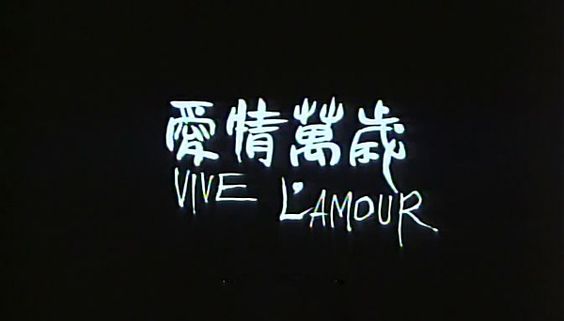
The Malaysia-born Taiwanese director, Tsai Ming-liang, is distinctive in Taiwanese cinema compared to equally well-known Edward Yang and Hou Hsiao-hsien, who are representatives of Taiwanese New Cinema. Instead of showing the rural views and hsiang-tu[1]culture of Taiwan as Hou and Yang did in 1980s, Tsai focuses on the living of city dwellers and is famous for his formalist experiment in long takes, slowness and few dialogues. As James Udden claims that “the films of Hou Hsiao-Hsien and Edward Yang are for the most part unthinkable without Taiwan. With Tsai [Ming-Liang], however, it is debatable whether these films are specifically about Taiwan or not”[2], the almost invariable theme of people’s solitude and alienation in Tsai’s works is not exclusive to Taiwan. This essay will analyse his Vive L’Amour (Ai qing wan sui, 1994) as an example and argues that Taiwan or Taipei, the city where this film was shot, is not an indispensable setting, but haunting in the film now and then. It is a similar case for his situation in Taiwanese New Cinema, as he is generally categorised in the “second wave” of it[3], yet vaguely on the edge.
Taiwanese New Cinema features its presentation and interpretation of Taiwan’s history on the screen, through which the films explore and examine the cultural and national identities of this island and common experiences of the people[4]. Even if in mid-1990s Hou and Yang began to change their attention from the traditional culture and nostalgia to the urban metropolitan culture and materialism[5], their works, except for those not set in Taiwan, are still identifiably Taiwan-centred. Tsai’s works also focus on the Taiwanese and are set in a highly capitalist and urbanised version of Taiwan, which is an outcome of modernisation; nevertheless, he concerns more about the inclusivity and universality of human nature and human desires. His films are naturalistic “minutiae of behaviour and environment”[6], thus accurately describing people’s daily lives. Yet Taipei, the city where Vive L’Amour was shot, seems not to serve as a unique background as the identifiability and the peculiarity of its appearance in the past has been transformed due to the massive construction and demolition of the urban infrastructure. His portrait of Taipei is detailed, mainly showing the empty houses for sale, cars (instead of people) on the road, a shopping centre, workplaces and a forest park, along with the sound of “electro-drones of car alarms and street-crossing signals competing with the constant chirruping of cell phones and doorbells”[7], yet they are not exclusive to Taipei. The highlighted sense of alienation and isolation shared by his three protagonists because of urbanisation can be found in most of the metropolitans, not necessarily in Taipei.
Despite sufficient displays of outdoor scenes of Taipei, most of the scenes are indoor in confined space such as the empty house, Lin’s own cramped apartment, a columbarium store and a café, which imply the director’s emphasis on individuals’ inside world. These places are also prevalent in every city, subverting the peculiarity of Taipei. The characters are alienated from other people and Taipei, as Hsiao Kang seems to be an invisible “ghost”[8] to the workers playing games at a workplace and Lin’s words are always ignored by her customers[9]. There are few dialogues in this film, most of which are around buying and selling, thus intensifying the materialism and utilitarianism in this society. Additionally, the three characters are usually alone, and even they meet each other, they tend not to talk a lot. For instance, Lin and Ah Jung do not talk face to face when they have sex; their only conversations exist via phone calls. Tsai seems to discover and exaggerate how people alienate from each other and how the city alienates them. Without enough depiction of human connection or their connection with the city, it is the materialism being stressed, not Taipei’s culture, history or itself. It has lost its local cultural identity and identities of place during modernisation; therefore, the new metropolitan culture is homogenised with other developed cities in the world.
Yet there is an exception of this universality, which is the Ta-an Forest Park in the last scene where Lin keeps crying for six minutes, serving as a hint of the history exclusive to Taiwan. The park was a debated construction project, as the site was previously a residential area for veterans of Chiang Kai-shek’s military, but 1257 houses were declared illegal and 1348 were demolished in 1992 in order to construct the new park[10]. Hence, the park serves as a symbol of the “gone city”, for which Lin is appointed as a mourner[11]. Braester also takes it as a connotation of “strong-handed government intervention in urban planning, disregard of city dwellers, and political dispute over Taiwan’s national myths”, underlining the history of gentrification in this particular city incorporated into the film and thus, the film’s concern about the city. In this way, Tsai could be interpreted as focusing on the contemporary stage of Taiwan in history, which has lost its identifiable Taiwanese character. Rather than recalling the past time and expressing the nostalgia, he concerns about the current city development and the “reformulation of the cultural landscape”[12], of which the topic is shared by Hou’s and Yang’s later works.
Another paradox can be found on the three protagonists who belong to nowhere, yet this lack of belonging to Taipei occurs when they inhabit Taipei. Lin, Ah Jung and Hsiao Kang should have their own places to live, yet they all take the empty house for sale as a refuge, where they sleep, bathe, have meals and have sex, implying that they cannot find a real home in Taipei. When Lin cries in the park, she still makes no connection to this place and seems just to find somewhere to sit down and cry. More accurately, she is a mourner for herself who can never build an intimate relationship with others. In this way, Taipei is only a name for the space where these “lost souls”[13] inhabit, but not a place with any special meaning to them. Tsai observes the damage of identity and culture imposed by modernisation and materialism upon the city dwellers and the loneliness they suffer from[14], but tends not to confine this phenomenon to Taipei. What is reflected in Vive L’Amour is not merely the cityscape and city dwellers of Taipei, but the emotion and the living condition shared by people throughout the world. This results in Taipei’s ambiguous situation in the film, as the protagonists are influenced by the urban development in the city, yet this influence is neither exclusive to the people nor to the city. Even the “look and sound” of present-day Taipei are demonstrated clearly, people’s lack of contact with the city also separates the city apart from their life. The meaning of Taipei where the Taiwanese live is reduced to merely a place holding rootless, homeless people. In other words, the city is in solitude in the film as well, which does not serve as part of the mise-en-scène, but merely a stage where the events take place.
With Tsai’s distinctive style of slowness and less thematic connection to Taiwan as a setting, it is debatable whether he should be categorised in Taiwanese New Cinema. This movement can also be named as “Taiwan New Cinema”, “New Taiwanese Cinema” or “Taiwanese New Wave”, hence being confusing and vague to some extent. Tsai distinguishes himself from this movement and has hinted at being not welcomed at first by some renowned directors[15]; while in most cases, he is still discussed under this heading owing to his works being based in Taiwan and his showing of Taiwan people. Therefore, it seems to be a compromising solution to situate him in the “second wave” of this movement which is more varied in styles and themes. The second wave or Second New Wave is considered to continue the “thematic cutting edge” in the first wave distinguished from melodramas, martial-arts films and the “Healthy Realist” cinema with Confucian ethics, and introduces the topics of sexuality, alienation and individual identity, in which Tsai is evidently engaged[16]. Yet this term which covers extremely different directors like Tsai and Ang Lee is so broad and vague that it is differentiated from the first wave on the government website, and could widely refer to the films released during 1990s and 2000s[17]. As a result, Tsai’s situation within Taiwanese New Cinema remains unclear and disputable. Concerning his unique cinematic style of extreme slowness and thematic emphasis on individuals, it is also not essential to categorise him into this movement.
In conclusion, Tsai Ming-liang’s films, exemplified by Vive L’Amour, are not exclusively or specifically about Taiwan, yet with them being shot in Taiwan, the cultural and historical transformations of this island are inevitably shown and reflected and thus, haunting on the screen. Meanwhile, Tsai is not a typical member in Taiwanese New Cinema as his thematic emphasis of individual alienation departs far from topics of the national identity and the local history in, for instance, Hou Hsiao-hsien and Edward Yang’s works, but considering his basis in Taiwan, there seems no choice to categorise him into any movement other than Taiwanese New Cinema, or more specifically yet still vaguely, the second wave of this movement. His works can be interpreted with reference to Taiwan’s contemporary stage of history while mainly concerning the isolated individuals and the society with common issues.
[1] June Yip, Envisioning Taiwan: Fiction, Cinema, and the Nation in the Cultural Imaginary (Durham: Duke University Press, 2004), 50.
[2] James Udden, “On the Shoulders of Giants: Tsai Ming-Liang, Jia Zhangke, Fruit Chan and the Struggles of Second Generation Auteurism,” in The Chinese Cinema Book, eds. Song Hwee Lim and Julian Ward (London: British Film Institute, 2011), 163.
[3] Chuck Stephens, “Intersection: Tsai Ming-Liang’s Yearning Bike Boys and Heartsick Heroines,” Film Comment 32, no. 5 (1996): 22, https://www.jstor.org/stable/43457711.
[4] Chris Berry and Feii Lu, “Introduction,” in Island on the Edge: Taiwan New Cinema and After, eds. Chris Berry and Feii Lu (Hong Kong: Hong Kong University Press, 2005), 5.
[5] I-Fen Wu, “Flowing Desire, Floating Souls: Modern Cultural Landscape in Tsai Ming-Liang’s Taipei Trilogy,” Cineaction, no. 58 (June 2002): 58.
[6] Tony Rayns, “Confrontations,” Sight and Sound 7, no. 3 (March 1997): 15.
[7] Stephens, “Intersection,” 21.
[8] Fran Martin, “Vive L’Amour: Eloquent Emptiness,” in Chinese Films in Focus: 25 New Takes, ed. Chris Berry (London: British Film Institute, 2003), 179.
[9] Robin Wood, “Vive L’Amour,” Film International 4, no. 19 (2006): 46.
[10] Yomi Braester, “Tales of a Porous City: Public Residences and Private Streets in Taipei Films,” in Contested Modernities in Chinese Literature, ed. Charles A. Laughlin (New York: Palgrave Macmillan, 2005), 165.
[11] Agata A. Lisiak, “Making Sense of Absence: Tsai Ming-Liang’s Cinematic Portrayals of Cities,” City 19, no. 6 (2015): 848, https://doi.org/10.1080/13604813.2015.1090186.
[12] Wu, “Flowing Desire, Floating Souls,” 59.
[13] Laurent Michelon, “Youth Culture and Urban Life in Taiwanese Cinema during the 1990s: In the Grip of the City’s Evil Ways,” China Perspectives, no. 18 (1998): 63, https://www.jstor.org/stable/24050680.
[14] Michelon, 63–65.
[15] Udden, “On the Shoulders of Giants,” 163.
[16] Berry and Lu, “Introduction,” 5–7.
[17] Flannery Wilson, New Taiwanese Cinema in Focus: Moving within and beyond the Frame (Edinburgh: Edinburgh University Press, 2015), 6.
Bibliography
Berry, Chris, and Feii Lu. “Introduction.” In Island on the Edge: Taiwan New Cinema and After, edited by Chris Berry and Feii Lu, 1–12. Hong Kong: Hong Kong University Press, 2005.
Braester, Yomi. “Tales of a Porous City: Public Residences and Private Streets in Taipei Films.” In Contested Modernities in Chinese Literature, edited by Charles A. Laughlin, 157–70. New York: Palgrave Macmillan, 2005.
Lisiak, Agata A. “Making Sense of Absence: Tsai Ming-Liang’s Cinematic Portrayals of Cities.” City 19, no. 6 (2015): 837–856. https://doi.org/10.1080/13604813.2015.1090186.
Martin, Fran. “Vive L’Amour: Eloquent Emptiness.” In Chinese Films in Focus: 25 New Takes, edited by Chris Berry, 175–82. London: British Film Institute, 2003.
Michelon, Laurent. “Youth Culture and Urban Life in Taiwanese Cinema during the 1990s: In the Grip of the City’s Evil Ways.” China Perspectives, no. 18 (1998): 61–67. https://www.jstor.org/stable/24050680.
Rayns, Tony. “Confrontations.” Sight and Sound 7, no. 3 (March 1997): 14–18.
Stephens, Chuck. “Intersection: Tsai Ming-Liang’s Yearning Bike Boys and Heartsick Heroines.” Film Comment 32, no. 5 (1996): 20–23. https://www.jstor.org/stable/43457711.
Udden, James. “On the Shoulders of Giants: Tsai Ming-Liang, Jia Zhangke, Fruit Chan and the Struggles of Second Generation Auteurism.” In The Chinese Cinema Book, edited by Song Hwee Lim and Julian Ward, 158–66. London: British Film Institute, 2011.
Wilson, Flannery. New Taiwanese Cinema in Focus: Moving within and beyond the Frame. Edinburgh: Edinburgh University Press, 2015.
Wood, Robin. “Vive L’Amour.” Film International 4, no. 19 (2006): 44–49.
Wu, I-Fen. “Flowing Desire, Floating Souls: Modern Cultural Landscape in Tsai Ming-Liang’s Taipei Trilogy.” Cineaction, no. 58 (June 2002): 58–64.
Yip, June. Envisioning Taiwan: Fiction, Cinema, and the Nation in the Cultural Imaginary. Durham: Duke University Press, 2004.
Filmography
Vive L’Amour. Directed by Tsai Ming-liang. Taiwan: Central Motion Pictures, 1994. Blu-ray.
 Maggie 叶芷灵